

Myopia Control in Children
Whom to Consult?
- Dr. Priya Basaiawmoit
- Dr. Liz Mary Santhosh
- Dr. Nita S
- Dr. Amita Verghese
What is myopia?
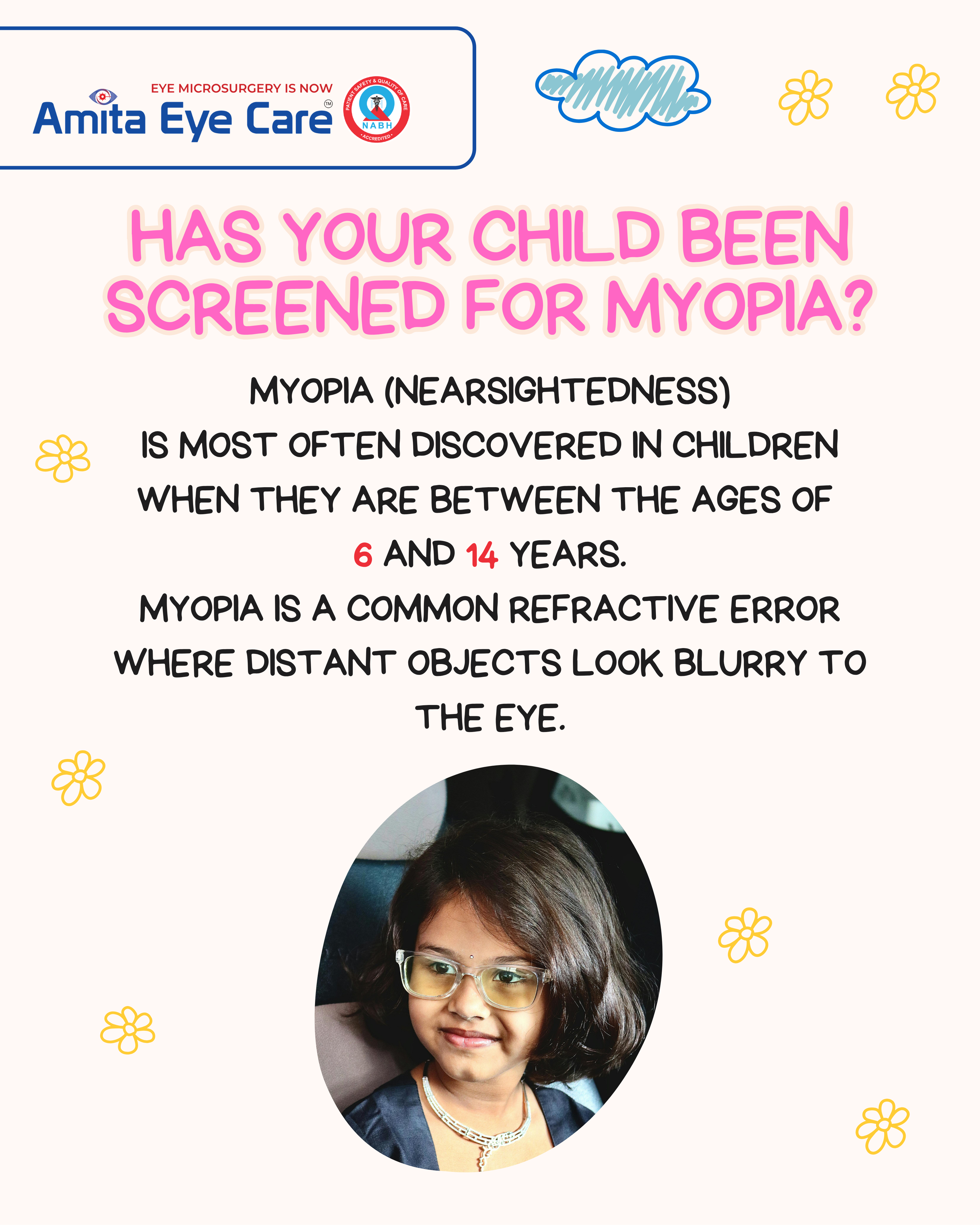
Myopia, commonly known as near-sightedness or short-sightedness, is a refractive error of the eye. In this condition, objects that are close to the eye appear clear, but distant objects appear blurry.
This happens when the eyeball grows too long, or the cornea becomes more curved than usual. This, in turn, causes light from the object you are viewing to fall ‘in front of’ the retina, instead of ‘on’ the retina.
Myopia is a lifelong condition, but early treatment and control methods during developmental years, can help slow it down to a great extent. These treatment methods are discussed below on this page.
What causes myopia in children?
It is normal for children’s eyes to grow during their developmental years. But if the eyes grow into an oval shape instead of round, it usually results in myopia. The causes mentioned below are the most common:
- * Genetics - if either of the child’s parents have myopia, the child is also at risk of developing this condition
- * Not spending enough time outdoors - Research shows that more time spent outdoors in natural daylight can greatly reduce the risk of myopia. Parents should encourage their children to spend 2 hours or more outdoors, in natural daylight, every day
What is progressive myopia?
Progressive myopia is near-sightedness that gets worse every year. If myopia progresses enough, it can become high myopia.
Myopia progression usually occurs during childhood and adolescence. However, it can also continue into early adulthood.
What are the risks of having high myopia?
When someone requires a correction of -4.00 to -6.00 dioptres (d) or more, it can be called high myopia.
High myopia happens when the eyeballs grow too long, or the curve of the corneas becomes too steep.
High myopia increases a child’s risk of developing several sight-threatening complications in adulthood. The most common complications are retinal detachment, glaucoma and cataract.
It is very important for adults having myopia to get their eyes screened at least 1-2 times a year.
Early signs to look for in your children that could indicate they have myopia:
- * difficulty reading the board in a classroom
- * difficulty playing outdoor sports
- * sitting too close to the TV, to be able to see what's on screen
- * squinting eyes often
- * rubbing eyes frequently
- * complaint of headaches
Reducing the risk of myopia in young children
1. Increasing outdoor activities like walking, running, sports:
Studies have shown that the more time a child spends outdoors in natural light, the lesser the growth in the axial length of their eyes. This means that spending as much time as possible outdoors can protect the eyes of children from developing myopia and can even reduce the risk of progression in those children who are already myopic.
2. Regular eye exams:
Some children are born nearsighted, while some may become nearsighted while growing up.
Young children often do not complain about their blurry vision or symptoms. That is why it is important to conduct eye exams and vision tests for them regularly.
Myopia usually begins in childhood, and the peak years of myopia progression are during childhood to adolescence.
- * Ideally, the first eye exam should be before the age of 1 year
- * next exam before starting playschool
- * third exam when starting first grade
- * annual exams throughout school and college
If your child has progressive myopia, they will likely need to have eye exams more frequently.
It's also critical to keep up with regular eye exams to ensure your child's vision prescription is up to date. If their lens prescription is too weak for their degree of myopia, it can increase the risk of myopia progression.
How to slow down the progression of myopia in children?
Progressive myopia can be slowed down with the help of specialized ‘myopia control glasses’ + eye-drops. This treatment is prescribed to children who are age 16 years or younger.
Each child is unique and a comprehensive consultation with an eye specialist is required to determine the best treatment plan for each child.
Myopia control methods can be effective, but only if they are used early enough; early detection is critical to slow down the progression of myopia.
Treatment method: Myopia Control lenses (eyeglasses)
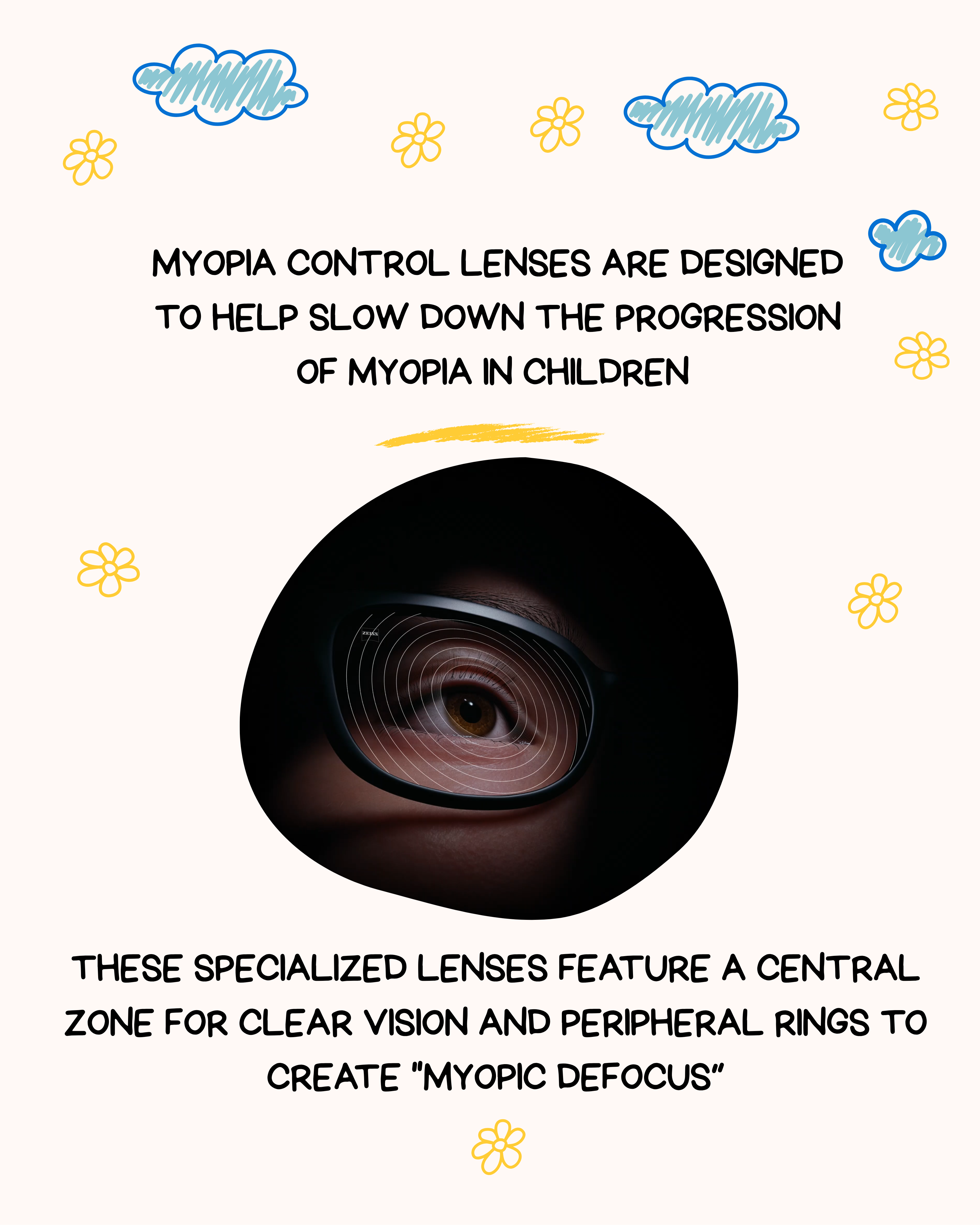
‘Myopia control lenses’, also called ‘myopia management lenses’ are designed to help slow down the progression of myopia in children.
These are specialized lenses that feature a central zone for clear vision and peripheral tiny lens-lets or rings to create "myopic defocus," which signals the eye to stop growing longer. Popular brands include:
- * Hoya MiYOSMART (DIMS technology)
- * Essilor Stellest (HALT technology)
- * Zeiss MyoCare® lenses (C.A.R.E technology)
Recent studies have shown that they can slow down the progression of myopia till up to 50 – 60 %.
Benefits & Effectiveness:
- * Slowing down myopia progression during childhood and teenage years means that they will have a lower eyeglass prescription when their vision stabilizes in adulthood
- * A lower eyeglass prescription reduces the risk of developing sight-threatening complications in adulthood
- * These lenses both correct blurry distance vision and manage the growth of the eye
- * The treatment is effective for the long-term
- * Spectacle lenses are easy and safe for children to use
Important Considerations:
- * These lenses are specifically designed for children and teenagers whose eyes are still developing
- * For best results, glasses must be worn daily otherwise they are not as effective
Treatment method: Atropine eye drops
Atropine eye drops, in extremely low doses (0.01% - 0.05 %) may be prescribed to children, for myopia control. Talk to your doctor to find the best treatment plan for your child.
It is important to note that the combination of atropine drops, and myopia control lenses works hand in hand to slow down progression of myopia. Children who have been prescribed atropine treatment for myopia control will still need to wear their prescribed spectacles to see clearly.
Difference between regular eyeglass lenses and myopia control lenses
| Single vision glasses | Myopia control glasses | |
|---|---|---|
| Purpose | They correct blurry distance vision by allowing the light to fall on the retina by bending the light rays | They serve a dual purpose: correct blurry vision while actively reducing the rate of myopia progression |
| Action | Helps an individual with myopia (or other refractive errors) to see clearly | Targets the underlying cause (elongation of the eye) using specialized optics |
| Suitable for | Single vision lenses are suitable for anyone with refractive errors (near-sightedness, far-sightedness, astigmatism) | Myopia control lenses are specifically designed for children and teenagers for whom nearsighted (myopia) prescriptions are increasing with time |
| Appearance | The lenses have a uniform appearance. In case of high myopia, the thickness of the glass may increase | The lenses can sometimes have a slightly different look (a faint ring or pattern) due to the treatment zones |
| Results | Vision is corrected, but it does not slow down the eye from growing further axially | Slows down axial growth of the eye, potentially lowering the final, adult prescription |
| Cost and Care | If the vision is stable, new glasses need not be purchased frequently. However, one must be careful not to damage, scratch, bend, or break their glasses | Myopia control lenses are a specialty treatment, making them more expensive than standard glasses. They too, need to be handled with care. |
| Doctor visit frequency | Once in 6 -12 months, based on doctor’s advice | More frequent follow-up visits to monitor eye growth |
Impact of myopia on daily life
Children and adolescents who have myopia or progressive myopia live a normal life, but may struggle with some of these practical problems:
- * may have difficulty in school due to not being able to see the chalkboard/ whiteboard
- * might have less chances of pursuing careers like Police and Armed Forces, Aviation (Pilots), Police and Law Enforcement, Specialized Technical/Safety Roles, Cabin Crew, etc. These roles might require individuals to have uncorrected vision (6/6 or 20/20 vision without glasses)
- * might find it difficult to play sports that require long distance vision (cricket, football, etc.)
- * might find it difficult to play sports that risk damage to spectacles (football, basketball, etc.)
- * may have difficulty watching tv or watching movies at the movie theatre
- * may not be able to fully engage in activities like swimming and water sports
- * might be at risk of infections if they wear contact lenses
- * might have heavy glasses that cause discomfort (in case of high myopia)
Clear vision today ensures a brighter future tomorrow
Consult our eye specialists to learn more about myopia and managing progressive myopia in children